01
Business-Driven Strategy
We connect SEO decisions to your products, margins, target markets, and the types of customers you actually want to attract.
We develop an organic traffic growth plan, improve website structure and pages, set up analytics, and monitor metrics related to inquiries and sales.
We begin by analyzing your business, market demand, competitors, and current website performance. SEO priorities are then built around commercial potential — not traffic for traffic's sake.
We connect SEO decisions to your products, margins, target markets, and the types of customers you actually want to attract.
Pages and search queries are prioritized by demand, competition, conversion potential, and expected business value.
We track implementation, rankings, organic traffic, leads, and commercial outcomes to understand what actually works.
Clear priorities, measurable progress, and an understandable roadmap instead of disconnected SEO activity.
A structure designed to grow across services, categories, locations, products, and international markets.
You understand what is being done, why it matters, and which metrics are moving as a result.
Traffic is not the final goal. We focus on search visibility that can generate inquiries, customers, and revenue.
Every project has different priorities. We combine technical, structural, content, authority, and analytics work into one coordinated SEO strategy.
Search demand analysis, clustering, page mapping, site structure, and scalable landing-page planning.
Indexation, crawling, internal architecture, duplicates, redirects, templates, performance, and technical barriers.
Landing-page optimization, search intent alignment, content briefs, metadata, and on-page improvements.
Improving page usefulness, commercial elements, navigation, conversion paths, and user experience.
Authority growth through relevant backlinks, competitor analysis, outreach, and controlled acquisition.
Rankings, traffic, conversions, leads, revenue signals, and ongoing assessment of SEO performance.
SEO rarely fails because of one missing keyword or one technical issue. Growth usually slows when several structural, content, authority, and measurement problems compound over time.
Important search intents are mixed together, buried too deep, or have no dedicated landing pages at all.
Pages may rank, but they compete for queries that do not match what users actually expect to find or buy.
Crawlers spend resources on duplicates, filters, weak pages, or technical URLs instead of valuable landing pages.
Traffic arrives, but pages do not answer enough questions, build confidence, or move users toward an inquiry.
Strong competitors keep the advantage because important pages lack enough relevant internal and external authority.
Rankings improve, but nobody connects organic visibility with qualified inquiries, customers, or commercial outcomes.
We look at SEO as a connected system. Improving one element matters only when the rest of the funnel can support it.
Where customers are already searching.
How search demand becomes a scalable site structure.
Which landing pages should capture each intent.
How important pages gain enough strength to compete.
How organic visitors become qualified inquiries.
What actually creates measurable business growth.
Not every SEO task deserves the same priority. We evaluate opportunities by potential impact, effort, competition, implementation complexity, and commercial value.
Indexation fixes, critical landing pages, internal linking, metadata improvements, and clear structural opportunities.
New page architecture, large content clusters, international expansion, major technical changes, and authority building.
Existing page improvements, CTR opportunities, cannibalization fixes, and smaller UX adjustments.
Tasks with weak demand, limited commercial value, or disproportionately high implementation cost.
Whether your important landing pages are becoming more visible for relevant search demand.
Growth in visitors arriving through queries that actually match your products and services.
Forms, calls, bookings, registrations, purchases, or whatever meaningful conversion exists in your business.
Where possible, we connect organic acquisition with revenue, customer quality, and commercial performance.
Priorities change as the project develops. We move from diagnosis and planning into implementation, measurement, and continuous expansion.
Technical audit, search demand, competitors, current rankings, site structure, analytics, and commercial priorities.
We map opportunities into an actionable roadmap and define which changes should be implemented first.
Technical changes, new pages, content optimization, internal linking, authority growth, and UX improvements.
We analyze results, identify the next growth opportunities, and continuously expand what is already working.
Explore real-world SEO projects, growth experiments, and the results achieved across different markets.
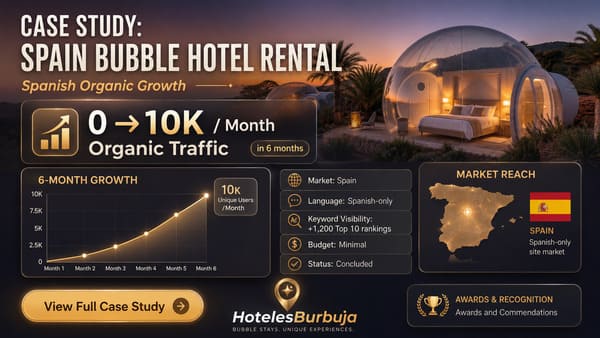 Spain
Spain Zero to 10,000 organic visitors per month in 6 months. This Spain-based bubble hotel rental site ranked Top 10 for 1,200+ keywords on a minimal budget.
 Global
 Sudoku Freeplay grew organic traffic from 0 to 10,000 users and search impressions up to 100,000 on a minimal budget. The campaign is still in progress.
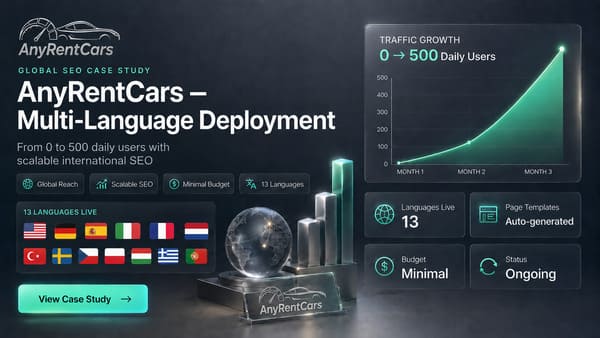 International
 AnyRentCars scaled from 0 to 500 daily users in 3 months with a multilingual SEO deployment across 13 languages, live auto-generated page templates, and a minimal budget.
Scope depends on your website, market, competition, and internal resources. We define priorities before the project begins and adapt the workload as the site grows.
Final scope depends on the size of the website, target markets, competition, and the amount of implementation required.
Discuss Your Project ↗A clear roadmap based on business goals, search demand, competition, and implementation resources.
Technical SEO, content, structure, internal linking, authority growth, and optimization work based on current priorities.
Rankings, traffic, conversions, implementation status, and new growth opportunities are reviewed continuously.
Content production, development, outreach, and external placements can be budgeted separately where required.
The exact strategy varies by project, but these are the questions we most often address before starting.
It depends on the current state of the website, competition, search demand, implementation speed, and authority. Some technical or on-page improvements can show movement quickly, while competitive growth usually requires sustained work.
We analyze technical health, search demand, competitors, site architecture, current rankings, analytics, and commercial priorities. The result is a prioritized SEO roadmap.
No. The scope can include research, technical recommendations, content planning, on-page optimization, internal linking, authority growth, analytics, and implementation tracking.
Yes. We can work alongside internal developers, editors, content teams, designers, and marketing specialists while keeping SEO priorities coordinated.
Yes. International SEO can include market research, language and country architecture, localized keyword research, landing-page structure, and expansion planning.
Website size, competition, number of markets, technical complexity, content requirements, and the amount of implementation work all affect the final scope.
Tell us about your website, target markets, and current growth goals. We’ll review the project and discuss where SEO can create the most value.
Get a Free Audit ↗